

Decoding the Seat of Consciousness Circa Science 2026
Updated: Apr 22
A Layman’s Guide to the Top 3 Theories of Consciousness from a science propspective
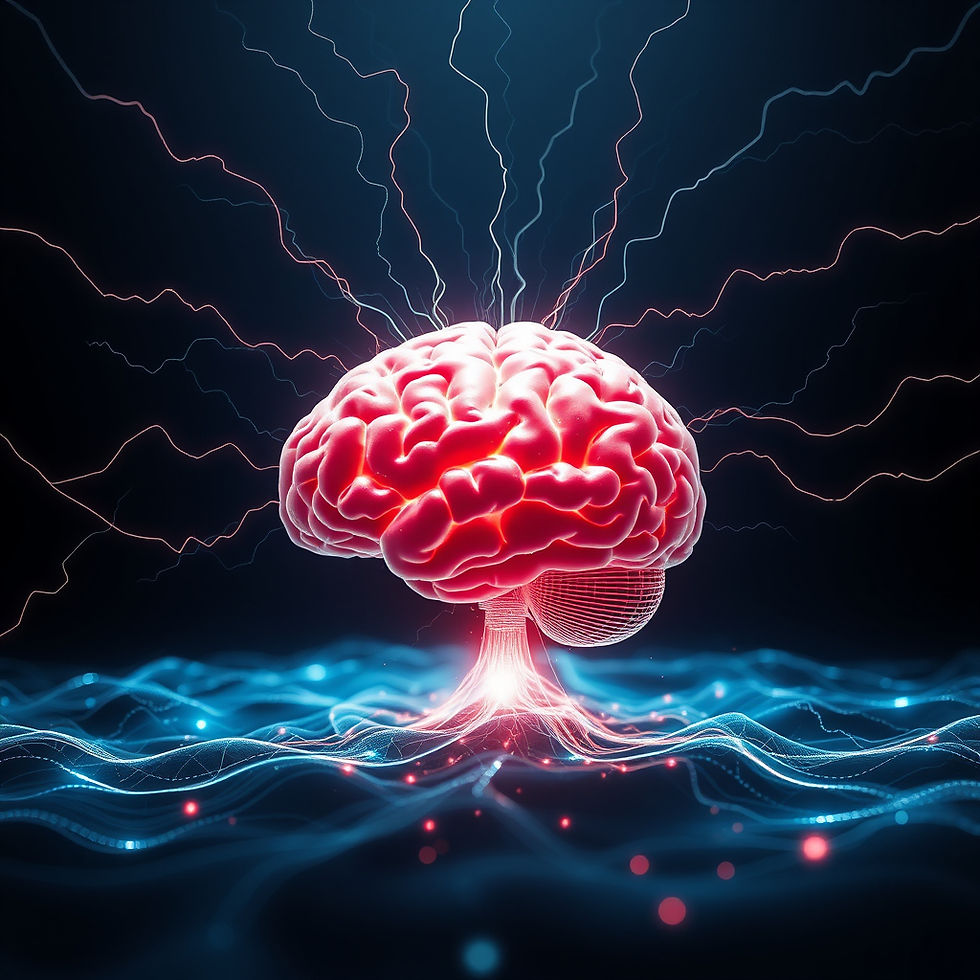
The quest to understand how the three-pound organ in our heads creates the feeling of "being" is one of science's greatest challenges, often called the "Hard Problem". In recent years, researchers have moved from philosophical speculation to "adversarial collaborations"—massive experiments designed to pit the most eminent theories against each other.
Here are the top three theories currently leading the field:
1. Global Neuronal Workspace Theory (GNWT): The Theater Spotlight
The Core Idea: GNWT suggests that consciousness is a functional process of "broadcasting" information. Our brains have many specialized modules (like vision, hearing, and memory) that work mostly in the dark. We only become "conscious" of something when it is selected and blasted across a global network, making it available to the rest of the brain.
The Analogy: Imagine a dark theater. Many actors (different brain modules) are performing various tasks in the shadows, but you can’t see them. Consciousness is the spotlight. Once the spotlight hits a specific actor, their performance is suddenly visible to the entire audience (the rest of your brain). This "global ignition" is what creates your conscious experience.
2. Integrated Information Theory (IIT): The Unbreakable Tapestry
The Core Idea: Unlike GNWT, which focuses on what the brain does, IIT focuses on what the brain is. Developed by Giulio Tononi, it proposes that consciousness is an intrinsic property of a system’s structure. If a system is both highly specialized (differentiated) and deeply interconnected (integrated), it creates a high value called Phi ($\Phi$). The higher the Phi, the more conscious the system is.
The Analogy: Think of consciousness as a masterfully woven tapestry. If you pull a single thread, the entire picture changes because every part is interconnected. You can't understand the picture by looking at individual threads; it only "exists" because they are all tied together. In this view, consciousness isn't "broadcast"—it simply is the state of being perfectly unified.
3. Higher-Order Theories (HOT): The Brain’s Internal Mirror
The Core Idea: HOT suggests that having a sensory experience (like seeing a red apple) isn't enough to be conscious of it. For consciousness to happen, the brain must create a "higher-order representation" of that state—essentially, a thought about a thought. You are conscious of a feeling only when your brain "notices" that you are having it.
The Analogy: Imagine a security guard sitting in a booth watching a bank of monitors. The cameras (your senses) are recording the hallway all day, but the event only becomes "important" when the supervisor (the higher-order part of the brain) looks at the screen and thinks, "Aha, I see someone in the hallway". Without that second level of "watching," the experience remains unconscious.
The Verdict?
A landmark 2025 experiment tested these theories by tracking the brain activity of 256 participants. Interestingly, neither theory came out on top. GNWT predicted heavy activity in the front of the brain (the "broadcast center"), while IIT looked for sustained connections in the back of the brain (the "integration zone"). The results were mixed, suggesting that consciousness might be more complex than any single model currently allows.


Comments